Some links below are affiliate links — if you buy through them I may earn a commission at no extra cost to you. I only recommend tools I’d actually use.
I lost a $4,200 project once because I forgot to follow up. Not because the client said no — because I never said anything at all. The lead came in on a Tuesday, I meant to reply “later that day,” and by the time I remembered, three weeks had passed and she’d hired someone else. That’s the quiet way freelancers lose money: not to bad work, but to bad follow-through.
If you’re running your client pipeline out of your inbox, a notes app, and sheer memory, you already know the pattern. A lead messages you, you reply once, and it falls into the gap between “I’ll get back to them” and “wait, did I already get back to them?” Multiply that across every inquiry, proposal, and past client who might rebook you, and you’ve got a leaky bucket where deals evaporate.
A CRM (customer relationship manager) fixes this by giving every lead and client a home — a place that reminds you who to follow up with, when, and what was said last. For solopreneurs, a good CRM isn’t about “managing a sales team.” It’s about not dropping the three or four conversations that are actually worth real money this month.
I spent several weeks testing the CRMs freelancers actually ask me about — all-in-one platforms that bundle CRM with contracts and invoicing, and pure-play CRMs that just track pipeline. Here’s how they stack up.
Quick Comparison Table
| Tool | Starting Price | Free Tier | Type | Automation | Best For |
|---|---|---|---|---|---|
| Bonsai | From $15/user/mo | Limited trial only | All-in-one (CRM + contracts + invoicing) | Strong | Best all-in-one for solo freelancers |
| HoneyBook | $36/mo ($29 billed annually) | No | All-in-one (CRM + proposals + payments) | Strong, very polished | Client-facing service pros (US/Canada) |
| Dubsado | $20/mo (Starter) | No (trial only) | All-in-one (CRM + workflows + forms) | Deepest automation of the group | Freelancers who want to automate everything |
| HubSpot CRM | Free forever; paid from ~$20/seat/mo | Yes, generous | Pure CRM (add-ons for marketing/sales) | Good, especially on paid tiers | Best free CRM, room to scale |
| Pipedrive | From ~$14–24/user/mo | 14-day trial only | Pure sales CRM | Good pipeline automation | Freelancers who sell/pitch a lot |
| Streak | Free tier available | Yes | Pure CRM (lives inside Gmail) | Basic-to-moderate | Solopreneurs who live in Gmail |
Bonsai — Best All-in-One CRM for Freelancers Try Bonsai ↗
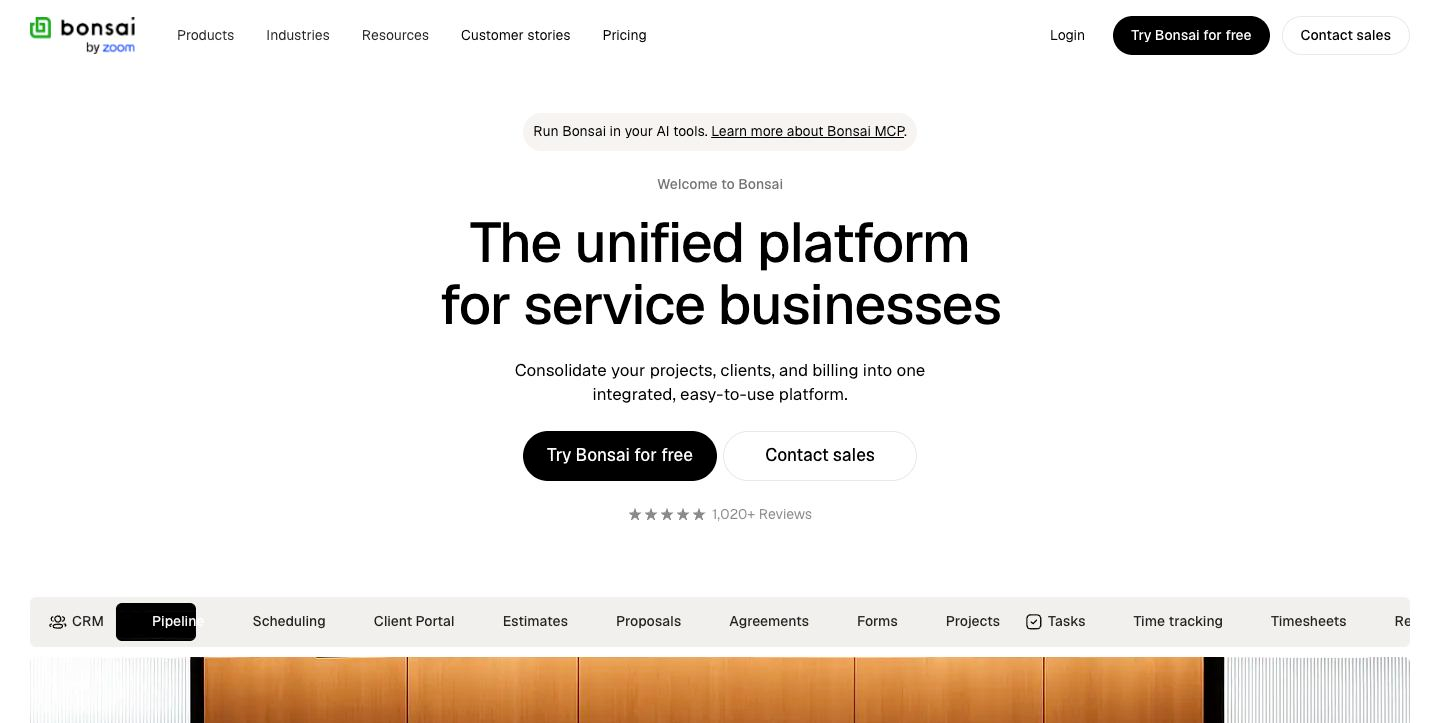
Bonsai was built specifically for freelancers, and it shows. The CRM sits inside a broader suite that also handles contracts, proposals, time tracking, invoicing, and even basic accounting — so your client’s contact info, project history, and unpaid invoices all live in one record instead of scattered across five apps.
What I liked most in testing: the pipeline view is genuinely simple. You drag a lead from “Inquiry” to “Proposal Sent” to “Won,” and Bonsai automatically links the contract and invoice tools to that same client card. For a one-person business, that’s the whole point — less app-switching, fewer things falling through the cracks.
Pros:
- True all-in-one: CRM, contracts, invoicing, and time tracking under one login
- Clean, freelancer-specific pipeline stages (not generic sales-team jargon)
- Automated client reminders reduce manual follow-up
- Global availability, not US-restricted
Cons:
- No meaningful free tier — you’re evaluating on a trial
- Some automation features are gated to higher tiers
- Reporting is lighter than dedicated sales CRMs like Pipedrive
Pricing starts from $15/user/mo. For most solo freelancers who want contracts, invoices, and lead tracking without duct-taping three tools together, this is the one I recommend first.
HoneyBook — Best All-in-One for US & Canada Service Pros Try HoneyBook ↗
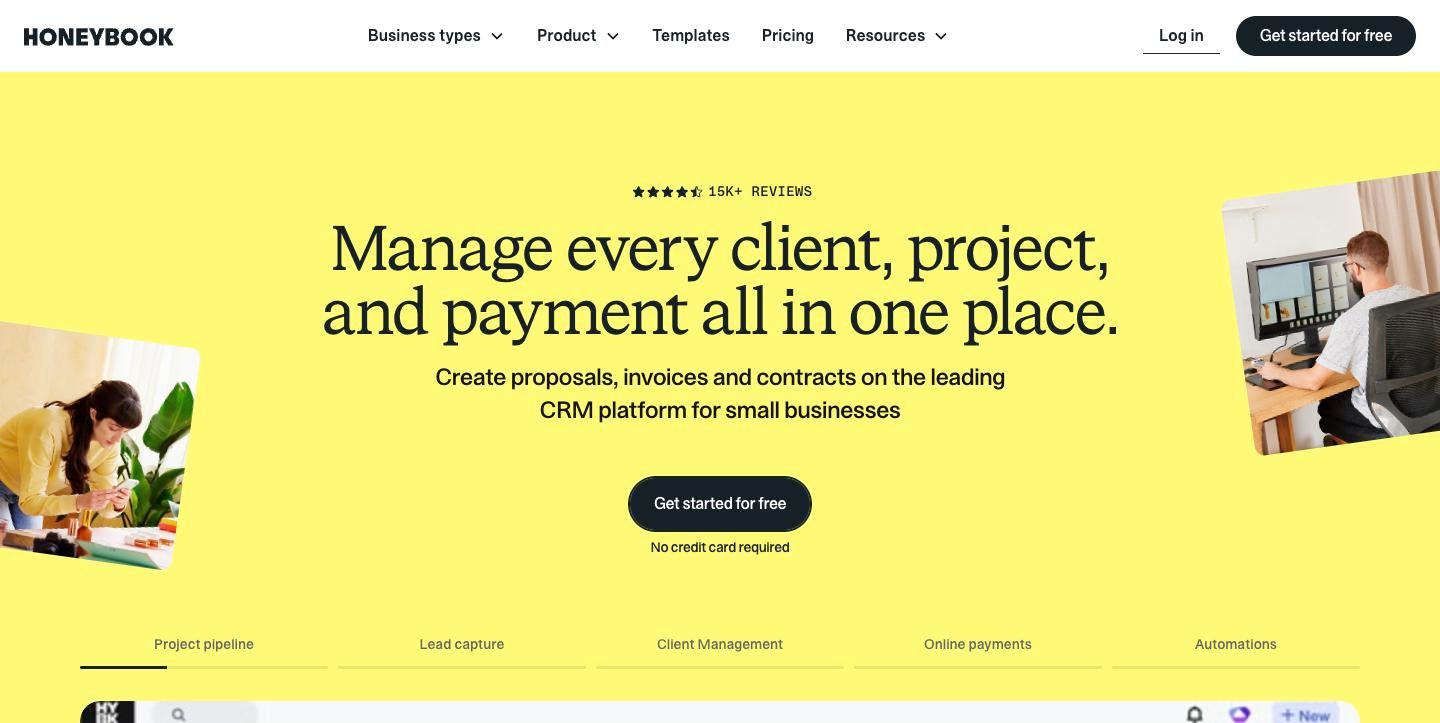
HoneyBook is the polished, design-forward alternative to Bonsai, and it’s especially popular with photographers, event pros, coaches, and consultants who care about how client-facing materials look. The CRM piece tracks every lead from first inquiry through booking, with branded proposals and contracts that feel more “boutique agency” than “freelancer spreadsheet.”
The automation is genuinely strong — you can set up sequences that send a welcome packet the moment someone fills out your inquiry form, then nudge them automatically if they haven’t responded in a few days. That’s exactly the kind of follow-up gap that costs freelancers money.
Pros:
- Best-in-class client-facing design (proposals, contracts, brand kit)
- Powerful automated workflows and reminder sequences
- Built-in scheduling and payments feel seamless for client-facing service businesses
Cons:
- Primarily built for US and Canada; international freelancers may hit friction
- Card processing fees run around 2.9% + $0.25 per transaction, which adds up
- Pricier entry point than Bonsai or Dubsado at $36/mo ($29/mo billed annually)
— when I trialed HoneyBook, the automated inquiry-to-booking sequence was the single feature that would have saved that $4,200 client I mentioned up top.
Dubsado — Best for Deep Automation, Global Try Dubsado ↗
Dubsado is the automation nerd’s CRM. Where Bonsai and HoneyBook give you good defaults, Dubsado gives you a blank canvas to build exactly the workflow you want — conditional logic, scheduled emails, forms that trigger contracts that trigger invoices, all without a developer.
That power comes with a steeper learning curve. Where Bonsai feels ready in an afternoon, Dubsado often takes a weekend of setup before it clicks. But once dialed in, it runs client onboarding almost entirely on autopilot — which matters if you take on new clients frequently and hate repeating the same intake process each time.
Pros:
- Most flexible automation and workflow builder in this list
- No transaction fees on payments (unlike HoneyBook)
- Works well globally, not just US/Canada
- Generous client/project limits even on the entry Starter plan
Cons:
- Steeper setup curve — not a same-day tool
- Interface feels less modern than HoneyBook’s
- No free tier, only a trial
Pricing: Starter at $20/mo, Premier at $40/mo. If you’re the type of freelancer who likes tinkering with systems until they’re airtight, Dubsado rewards that instinct more than any other tool here.
HubSpot CRM — Best Free CRM for Freelancers Try HubSpot ↗
HubSpot’s free plan is the most generous free CRM tier a freelancer will find, full stop. It’s not a stripped-down trial — it’s a genuinely usable contact database, deal pipeline, email tracking, and basic task reminders, free indefinitely for a single user.
The tradeoff: HubSpot is a pure CRM, built originally for sales and marketing teams. It won’t send contracts or invoices — you’ll still need separate tools for that (pairing it with a simple invoicing app is common). But if your main pain point is “I keep losing track of who I talked to and when,” HubSpot solves that for $0.
Pros:
- Free plan is legitimately powerful, not a bait-and-switch trial
- Scales into marketing/sales tools later if your business grows past solo
- Rock-solid reliability and a huge ecosystem of integrations
Cons:
- Not built for freelancers specifically — no contracts, proposals, or freelancer-style invoicing
- Paid tiers get expensive fast once you add “Hubs” beyond core CRM
- Can feel like overkill/corporate for a one-person shop
Paid plans start around $20/seat/mo. If budget is tight and you just need reliable lead and follow-up tracking, start here — you can always add invoicing tools alongside it.
Get the free Freelancer Tool Stack
Pipedrive — Best Pure Sales CRM Try Pipedrive ↗
Pipedrive is built for one job — managing a sales pipeline — and does it better than any all-in-one tool here. If a meaningful part of your business involves pitching, following up on proposals, and chasing deals through multiple stages, Pipedrive’s visual pipeline is the clearest way I’ve seen to track that.
It’s not trying to be your contract or invoicing tool, which is a feature, not a bug — it stays focused and fast. For freelancers with a longer sales cycle (consultants, agency-of-one types selling retainers), that focus is worth the extra app in your stack.
Pros:
- Best-in-class visual pipeline and deal tracking
- Strong automation for follow-up reminders and email sequences
- Fast, uncluttered interface — built for salespeople, not admins
Cons:
- No free tier, only a 14-day trial
- No contracts, proposals, or invoicing — pure pipeline tool
- Overkill if you only juggle a handful of leads at a time
Pricing runs from roughly $14–24/user/mo depending on tier. Best suited to freelancers whose bottleneck is closing deals, not managing paperwork.
Streak — Best CRM If You Live in Gmail Try Streak ↗
Streak turns your Gmail inbox into a CRM — no separate app, no new login. Every email thread can become a pipeline entry, with stages, notes, and reminders tracked right next to the conversation. For freelancers who already do 90% of client communication by email, this removes the friction of “logging” activity into a separate system, because the system is your inbox.
It’s not as feature-rich as the dedicated platforms above, but that’s the point — it’s the lowest-effort way to stop losing track of leads without adopting a whole new tool.
Pros:
- Zero context-switching — works directly inside Gmail
- Genuine free tier for solo use
- Very fast to set up (minutes, not hours)
Cons:
- Limited outside the Google ecosystem — no help if you use Outlook or another inbox
- Automation is basic compared to Dubsado or HoneyBook
- Can get pricey at higher tiers for what you get
Free tier available; paid plans run roughly $15–129/user/mo depending on features. Good starter CRM, but freelancers who outgrow it usually migrate to Bonsai or HubSpot within a year.
How to Choose the Right CRM
Ask yourself three questions before picking a tool:
1. Do I need contracts and invoicing bundled in, or just lead tracking?
If you’re juggling a separate contract tool, invoicing tool, and notes doc for leads, an all-in-one (Bonsai, HoneyBook, Dubsado) saves real time. If invoicing is already sorted and you just need to stop losing leads, a pure CRM (HubSpot, Pipedrive, Streak) is lighter and cheaper.
2. Where are my clients based?
HoneyBook is optimized for the US and Canada, including payment processing. If you work internationally, Bonsai or Dubsado will feel less friction-prone.
3. How much am I willing to set up?
Dubsado’s automation ceiling is highest here, but it demands setup time. Bonsai and HoneyBook are closer to plug-and-play. Streak is the fastest to start using today.
Verdict
- Best overall: Bonsai — the best balance of freelancer-specific CRM, contracts, and invoicing without a steep learning curve.
- Best free: HubSpot CRM — an unusually generous free tier that actually works for real pipeline tracking.
- Best all-in-one: HoneyBook if you’re US/Canada-based and want polish; Dubsado if you’re global or want deeper automation.
- Best pure sales CRM: Pipedrive, if closing deals — not paperwork — is your bottleneck.
- Who should skip a CRM entirely: If you take on fewer than 3–4 new clients a year and mostly work with repeat clients, a well-maintained spreadsheet with follow-up dates and a recurring calendar reminder will do the job. A CRM earns its keep once you have more leads in flight than you can hold in your head — usually somewhere around 5–10 active conversations at once.
Get the free Freelancer Tool Stack
The 18 tools that run a one-person business — invoicing, contracts, time, AI writing, automation and money. One checklist, no fluff.
FAQ
Do freelancers actually need a CRM, or is that overkill for a one-person business?
If you’re only handling a couple of leads a month, a spreadsheet works fine. Once you have several leads, proposals, and past clients to track simultaneously, a CRM prevents the “I forgot to follow up” problem that quietly costs freelancers real income.
What’s the difference between an all-in-one CRM and a pure CRM?
All-in-one tools like Bonsai, HoneyBook, and Dubsado bundle client tracking with contracts, proposals, and invoicing. Pure CRMs like HubSpot and Pipedrive focus only on tracking leads and deals — you’d pair them with separate invoicing or contract tools.
Is HubSpot’s free CRM actually good, or just a limited trial?
It’s a real free plan, not a time-limited trial. You get contact management, deal tracking, and email logging for free indefinitely — the paid tiers add marketing and sales automation features on top.
Can I use Streak if I don’t use Gmail?
No — Streak only works inside Gmail/Google Workspace. If you use Outlook or another email provider, look at HubSpot or Pipedrive instead.
Which CRM is cheapest for a freelancer just starting out?
HubSpot’s free tier costs nothing, and Streak also has a usable free plan. Among paid options, Dubsado’s Starter plan at $20/mo is the most affordable all-in-one entry point.
Does HoneyBook work outside the US and Canada?
It can technically be used elsewhere, but its payment processing and support are optimized for the US and Canada. International freelancers generally have a smoother experience with Bonsai or Dubsado.