Some links below are affiliate links — if you buy through them I may earn a commission at no extra cost to you. I only recommend tools I’d actually use.
Every roundup in this category, including the first version of this one, ranks proposal tools the same way: templates, design control, e-signature, tracking, price. That ranking assumes you send proposals the way a sales team does — steadily, every month, forever. You don’t. You send four in a week because two referrals landed at once, then you send none for six weeks because you’re delivering the work you won.
The subscription doesn’t know that. It bills every month, at the same rate, whether you sent nine proposals or zero. So the number that actually matters for a one-person business isn’t the sticker price on the plan page — it’s what one sent proposal costs you across a real year, and what it costs you to switch the tool off in the months you have nothing to send.
I rebuilt this comparison around those two numbers. Six tools, all of them capable of producing a proposal a client can sign on a phone. What separates them is what they meter, what they charge when the meter runs out, and what happens after the client says yes.
A proposal tool bills in months. Work does not arrive in months.
Here is the mismatch in one sentence: every tool on this list is priced per seat per month, and no freelancer sends proposals per seat per month.
Two freelancers can send exactly the same number of proposals in a year — say 24 — and pay wildly different effective rates for it, purely because of how those 24 were distributed. Spread evenly at two a month, an annual plan looks cheap. Bunched into three busy quarters with a dead one in between, you paid a full quarter of subscription for nothing, and the “cheap” annual rate is the reason you couldn’t stop.
That is not an argument against paying for proposal software. It’s an argument for pricing it the way you’d price any other business input: per unit of output. Which is what the tables below do.
What the cheapest sendable plan costs, and what it meters
The first correction to make is that the headline price on most of these plan pages is not the price of sending a proposal. On Bonsai it’s a tier that doesn’t include proposals at all. On PandaDoc it’s a paid tier you may not need, because the free one sends documents. Here is the cheapest plan on each tool that will actually put a signable proposal in front of a client, with the annual and monthly rates side by side.
| Tool | Cheapest plan that sends a proposal | Billed annually | Billed monthly | What the plan meters |
|---|---|---|---|---|
| PandaDoc | Free eSign | $0 | $0 | 60 documents a year — about five a month |
| Better Proposals | Starter | $13/user/mo — $156/yr | $19/user/mo | 5 proposals a month |
| Proposify | Basic | $19/user/mo — $228/yr | $29/user/mo | 10 sends a month, then $0.50 per send |
| Dubsado | Starter | $335/yr | $35/mo | Sends unlimited; free trial capped at 3 clients |
| Bonsai | Premium | $29/user/mo — $348/yr | $39/user/mo | Sends unlimited; the $9 Basic tier has no proposals |
| HoneyBook | Starter | $29/mo — $348/yr | $36/mo | Sends unlimited; 2.9% + $0.25 on card payments |
Read the last column before the third one. Three of these six meter your sends, and the two cheapest paid plans meter them hardest: Better Proposals Starter stops at five proposals a month, and Proposify Basic includes ten and then charges you fifty cents a send. Neither cap is a problem at freelance volume — that’s the point. You are not going to outgrow them, so paying for the tier above is money spent on headroom you will never use.
The send limit is the price, and nobody prints it in the comparison chart
Search this category and you will find a dozen tables comparing templates, integrations and “analytics”. You will almost never find the send allowance, which is the only line that can turn a $156 plan into a $300 one.
PandaDoc’s free tier is the clearest example of why it matters. Sixty documents a year sounds like a starter-plan tease until you convert it: five a month, every month, at no cost, with legally binding e-signature. For a freelancer who writes the proposal in Google Docs anyway and just needs it delivered, tracked and signed, that is not a trial. That is the answer. We reached the same conclusion from the other direction when we put PandaDoc head-to-head with Proposify and found the two of them charging an identical $228 a year for very different things.
Better Proposals runs the opposite play. The $13 annual rate is genuinely the cheapest paid entry here, and the five-a-month cap on Starter is invisible until the month you need a sixth. In practice most solo freelancers never hit it. If you do hit it twice in a year, you have a good problem and the Premium tier’s fifty-a-month allowance is the fix.
Proposify is the honest middle: ten sends included, overage priced openly at $0.50. That’s a tool telling you what a marginal proposal costs, which is more than the unlimited plans do — on those, the marginal cost is hidden in the months you send nothing.
What one proposal actually costs you, at three volumes a freelancer really has
Now the arithmetic. I took the annual price of each plan above and divided it by three send patterns I’ve actually lived through: a steady one a month, a busy three a month, and the lumpy year where eight proposals go out in one quarter and the rest of the calendar is delivery work.
| Plan (billed annually) | Cost for the year | 12 proposals sent | 36 proposals sent | 8 proposals sent |
|---|---|---|---|---|
| PandaDoc Free eSign | $0 | $0.00 | $0.00 | $0.00 |
| Better Proposals Starter | $156 | $13.00 | $4.33 | $19.50 |
| Proposify Basic | $228 | $19.00 | $6.33 | $28.50 |
| Dubsado Starter | $335 | $27.92 | $9.31 | $41.88 |
| Bonsai Premium | $348 | $29.00 | $9.67 | $43.50 |
| HoneyBook Starter | $348 | $29.00 | $9.67 | $43.50 |
Three things fall out of that table, and none of them show up in a features chart.
First, the gap between the tools narrows dramatically as volume rises and widens dramatically as it falls. At 36 proposals a year, the spread between the cheapest paid tool and the most expensive is about five dollars a proposal — noise, against a project worth four figures. At eight proposals a year, that same spread is twenty-four dollars a proposal, and the all-in-ones are charging you more per send than a decent template costs to have designed once.
Second, none of these numbers is large enough to justify agonising if you win the work. A $43.50 cost per proposal is irrelevant on a $3,000 project and ruinous on a $200 one. Which means the real filter isn’t the tool, it’s your project size and rate. Below a certain deal value, no paid proposal tool pays for itself and you should be on the free route.
Third — and this is the one that changed my own setup — PandaDoc’s free tier covers all three of those volumes. Thirty-six sends a year is comfortably inside a sixty-document allowance. So every dollar in the rows below it is being spent on something other than delivery: design control, tracking, or the handoff after the client signs. Those are real things worth paying for. But you should know that’s what you’re buying, rather than assuming you’re buying the ability to send a proposal at all.
The month you send nothing: what it costs to be able to stop
Every annual price above is a discount you buy with a twelve-month commitment. Monthly billing is the same product with an exit. Here is what that exit costs.
| Plan | Annual, paid up front | Monthly rate × 12 | Flexibility premium |
|---|---|---|---|
| Better Proposals Starter | $156 | $228 | +$72 |
| Proposify Basic | $228 | $348 | +$120 |
| Dubsado Starter | $335 | $420 | +$85 |
| HoneyBook Starter | $348 | $432 | +$84 |
| Bonsai Premium | $348 | $468 | +$120 |
The premium for paying month to month runs $72 to $120 a year. Convert it into months of freedom and the decision gets easy: on Better Proposals, the extra $72 buys back the right to switch off, and switching off for four months saves you $76. Roughly break-even. On Proposify and Bonsai, the $120 premium needs you to genuinely pause for four to five months before it pays.
So the rule I’d give a freelancer with seasonal work — the wedding photographer, the tax-adjacent consultant, anyone whose enquiries collapse for a quarter — is this: if you can name the months you’d cancel, pay monthly. If you can’t name them, you won’t cancel, and the annual rate is simply cheaper. What you should not do is pay the monthly premium “for flexibility” and then keep the subscription running all twelve months anyway, which is what most of us do.
One tool sidesteps the question entirely. Dubsado’s free trial has no clock on it — it’s capped at three clients instead of thirty days. You can build your entire proposal workflow, send it to three real people, and only start paying when the fourth arrives. For anyone still validating whether this is a business, that’s the most generous on-ramp in the category.
Get the free Freelancer Tool Stack
Two numbers in the August version of this article were wrong
This piece originally ran with a table listing Dubsado’s Starter tier at $20 a month and Bonsai’s entry plan at $15 with proposals included. Both were out of date by the time you read them.
Dubsado repriced on 1 December 2025 alongside its 3.0 release: Starter is now $35 a month or $335 a year, and Premier is $55 a month or $525 a year. That’s a 75% increase on the number we published, and it moves Dubsado from “the cheap all-in-one” to roughly level with HoneyBook and Bonsai. The pitch is unchanged — no platform markup on payments, genuinely global — but the price argument we made for it no longer holds.
Bonsai’s plan lineup was renamed and re-cut. The $9-a-year-billed Basic tier that its own homepage leads with does not include proposals; the cheapest tier that does is Premium at $29 per user per month billed annually. We found the same thing when we worked through Bonsai against HoneyBook and discovered that Bonsai Premium and HoneyBook Starter cost exactly the same $348 a year. Bonsai’s grid has moved twice in a year, so check the current tier names on their pricing page before you commit — the numbers here are what we verified this month, not a permanent fact.
I’d rather correct this in place than leave a wrong price ranking a tool for another six months. If you bought on the old table, the Dubsado increase is the one worth re-checking on your next renewal.
What happens after the client says yes
This is where the category actually splits, and it splits more cleanly than any features table suggests.
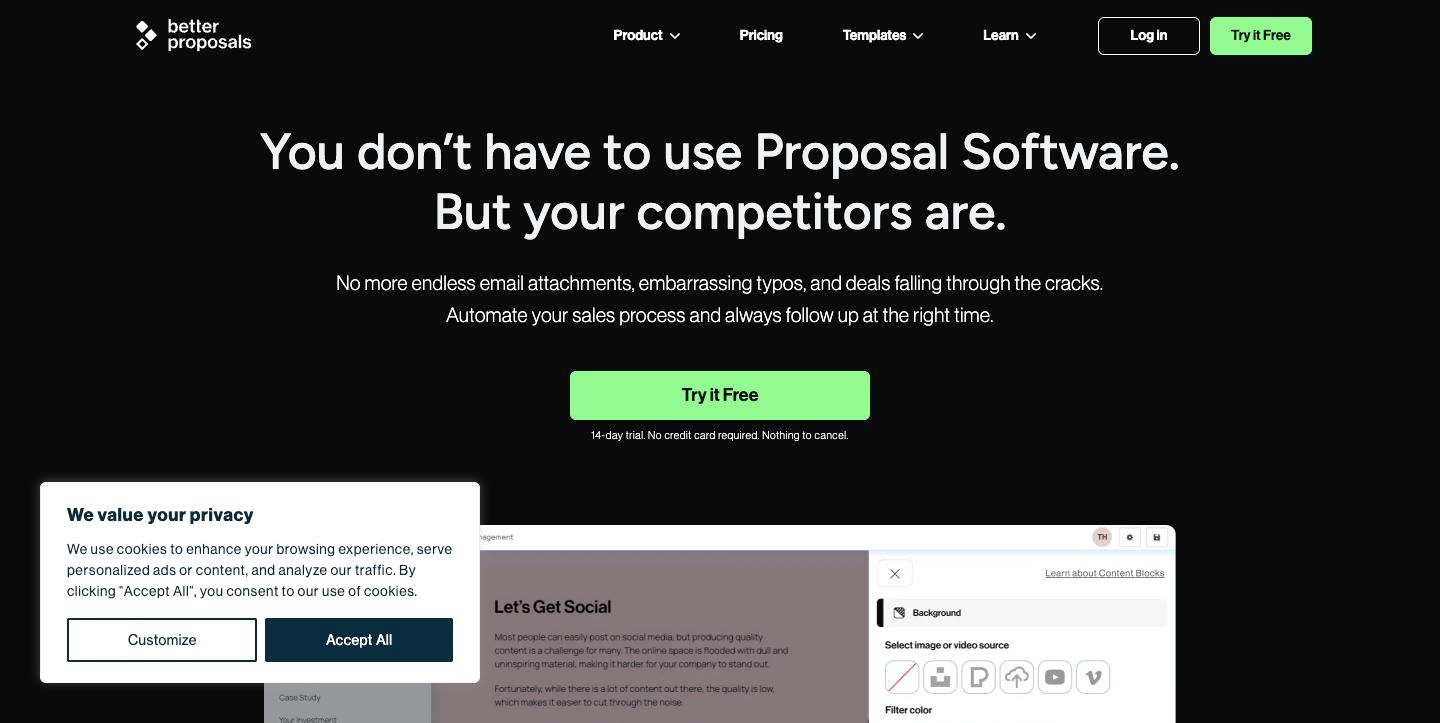
Better Proposals, Proposify and PandaDoc stop at the signature. That’s a design choice, not a shortfall — they make the document look right, tell you when it was opened, and get it signed. What happens next is your problem, which is fine if you already have a contract tool you trust and an invoicing setup you like.
Bonsai, HoneyBook and Dubsado carry the client through: proposal, contract, deposit, invoice, sometimes scheduling and a client portal too. The proposal is one screen in a pipeline. That’s genuinely less friction for the client — view, sign, pay a deposit, all without leaving one link — and it’s why these three cost more.
The cost of that convenience shows up in payment fees, and they are not identical. HoneyBook processes payments itself and charges 2.9% + $0.25 on Visa and Mastercard, 3.4% + $0.09 on Amex and card-on-file, and 1.5% on ACH bank transfers. Dubsado adds no markup of its own — you connect Stripe, Square or PayPal and pay their rate directly, which for a US Stripe account is 2.9% + $0.30 on cards and 0.8% on ACH capped at $5. Bonsai and PandaDoc likewise depend on the processor you connect.
On small deposits those differences are rounding errors. On a year of five-figure invoicing they are not, and we ran that exact arithmetic in the Bonsai vs HoneyBook comparison — the processing line can outweigh the subscription gap several times over. If most of your clients pay by bank transfer, the ranking changes again, which is the case we make in Stripe vs PayPal for freelancers.
The $0 route, and the exact point it stops working
You can run a completely respectable proposal process for nothing. Write the proposal in a document you control, export it as a PDF, and send it through PandaDoc’s free tier for a tracked, legally binding signature. Sixty documents a year. No card required.
What you give up is specific and worth naming:
- Design consistency. Your PDF looks like your PDF. It won’t have the mobile-first, scroll-to-sign layout that Better Proposals and Proposify produce out of the box, and on premium-priced work that gap is visible.
- Engagement data. You’ll know the document was opened. You won’t know they read the pricing section four times, which is the signal that tells you to call instead of emailing again.
- Re-use speed. Rebuilding a proposal from a template you maintain by hand takes longer every time your services change. A tool’s template library absorbs that.
- The handoff. No deposit collection, no contract attached, no automatic invoice.
The free route stops working when any one of those becomes the thing costing you deals. In practice that’s usually the engagement data, and usually somewhere between five and ten proposals a month. Until then, spending $348 a year to send eight proposals is a decision you’d never make about any other business input. If your proposals are losing on content rather than delivery, no subscription fixes that — the structure of the document is the higher-leverage change.
My picks, by how the work actually arrives
If you send fewer than five proposals a month and write them elsewhere: PandaDoc’s free tier, and spend nothing. This is most freelancers, most of the time, and I’d rather you put the $156 into a designer making one template look expensive.
If proposals are your bottleneck and you want them to look like an agency’s: Better Proposals Starter, $156 a year. Cheapest paid entry here, the five-a-month cap is above your real volume, and the open-tracking data is the feature that changes behaviour rather than just decorating the dashboard.
If you pitch high-ticket work and want control over every layout decision: Proposify Basic at $228. You’re paying the extra $72 for design latitude and page-by-page analytics, and the ten included sends plus $0.50 overage means the meter is legible.
If you want one system from enquiry to paid invoice, and your clients are in the US or Canada: HoneyBook Starter, $348. The client-facing flow is the most polished of the three all-in-ones and the payment rails are local. Read the fee schedule before you assume it’s cheaper than Bonsai — our HoneyBook review goes through what the Starter tier withholds.
If you want one system and you’re outside North America: Dubsado Starter at $335. It costs more than it did in August and the interface still feels a decade old, but no platform markup on payments and a genuinely global setup make it the better fit outside the US — the case we lay out in the Dubsado review and in Dubsado vs HoneyBook.
If you already pay for time tracking, invoicing and a CRM separately: price out Bonsai Premium at $348 against the sum of what you’re running. That’s the only situation where the all-in-one is a saving rather than an upgrade, and the Bonsai review has the tier-by-tier detail.
Who should skip this category entirely
Skip paid proposal software if any of these is true:
- Your average project is under about $500. At eight to twelve proposals a year, an all-in-one costs $29 to $43 per send. On a $400 project with a one-in-three close rate you’re spending over $100 of a $400 job before you start.
- You win work by referral and rarely pitch. If clients arrive pre-sold and you send a scope and a price rather than a pitch, you need a good email and an invoice, not a proposal platform.
- You’re still deciding whether freelancing is the plan. Use Dubsado’s three-client trial or PandaDoc’s free tier and revisit in six months with real numbers.
- Your close rate problem is a positioning problem. No template fixes a proposal that’s competing on price against four other people. That’s a pipeline question, not a software one.
And if you’re assembling the rest of the stack around this decision, the complete solo toolkit maps the other silos, while the rest of this silo lives under proposals, contracts and CRM.
Get the free Freelancer Tool Stack
The 18 tools that run a one-person business — invoicing, contracts, time, AI writing, automation and money. One checklist, no fluff.
Frequently asked questions
What is the cheapest way to send a proposal a client can legally sign?
PandaDoc’s free eSign tier, at $0 for up to 60 documents a year. You write the proposal wherever you like, upload the PDF, and the signature is legally binding. The cheapest paid option is Better Proposals Starter at $13 per user per month billed annually, which caps at five proposals a month.
Is Better Proposals really limited to five proposals a month?
On the Starter plan, yes. Premium raises it to 50 a month and Enterprise is unlimited. Most solo freelancers never approach the Starter cap, so the limit is usually a reason to stay on the cheap tier rather than a reason to avoid the tool.
Did Dubsado get more expensive?
Yes. Pricing changed on 1 December 2025 with the 3.0 release. Starter moved to $35 a month or $335 a year and Premier to $55 a month or $525 a year. Dubsado still adds no markup on payments — you pay your connected processor directly — but it is no longer the budget all-in-one.
Should I pay annually or monthly?
Annually, unless you can name the specific months you would cancel. The monthly premium runs $72 to $120 a year depending on the tool, which only pays for itself if you genuinely switch the subscription off for four or more months.
Do proposal tools charge fees on the money my client pays?
Only the ones that process payments. HoneyBook charges 2.9% + $0.25 on Visa and Mastercard, 3.4% + $0.09 on Amex and card-on-file, and 1.5% on ACH. Dubsado, Bonsai and PandaDoc pass you through to a processor like Stripe or PayPal at that processor’s rate. Better Proposals and Proposify don’t take payments at all.
Can I move my templates to another tool later?
From the proposal-only tools, easily — they hold documents, not your client history. From an all-in-one, it’s a bigger job, because your contracts, invoices and client records live there too. That asymmetry is worth weighing before you consolidate everything into one platform.
Prices verified in September 2026 against each provider’s published plans. Software pricing in this category has moved twice in twelve months — check the current plan grid before you buy.