The moment a client texts your personal number at 11 p.m. asking whether the revised logo is ready, you have a business-line problem. Not a big one, but a real one: your private phone is now part of your service desk. The two names that come up first are Google Voice and OpenPhone, and they solve the problem in quite different ways.
A note on naming before we start. OpenPhone now sells under the name Quo; the pricing page still carries the OpenPhone Technologies name in its footer. This article says “OpenPhone (Quo)” and means the same product. Every price below was read from the vendors’ own pages on 12 October 2026 and will drift, so check the linked page before you buy.
The short version, with the numbers first
| Plan | Price per user / month | What the page says is included |
|---|---|---|
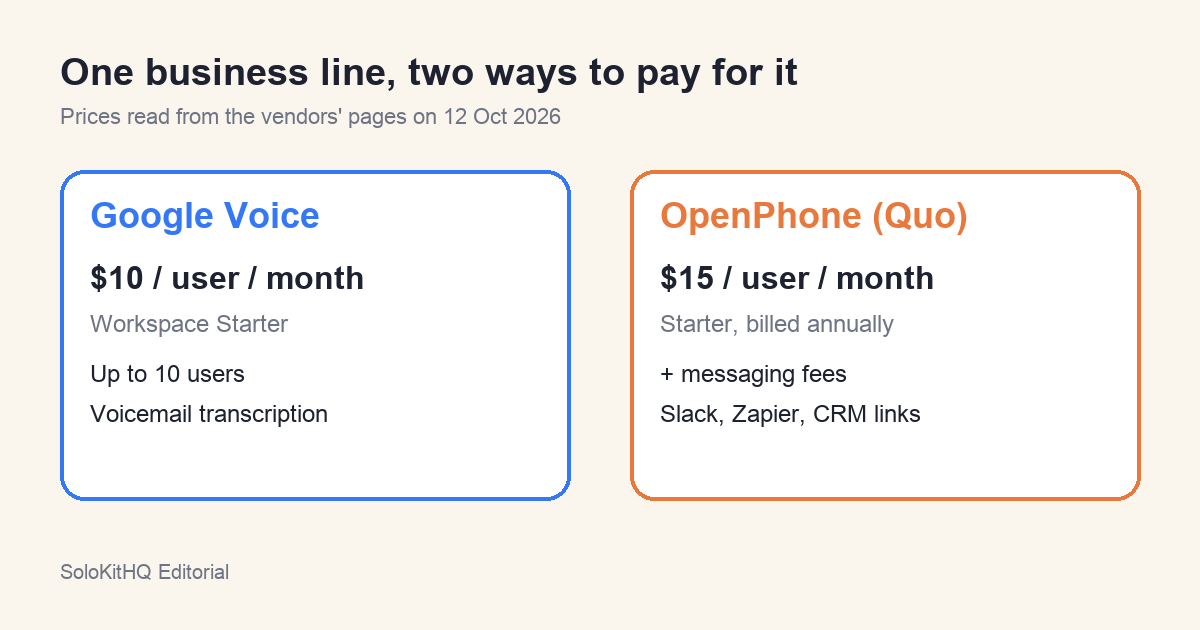
| Google Voice Starter | $10 | Up to 10 users, 14 countries, unlimited US texting, voicemail transcription, call transfers |
| Google Voice Standard | $20 | Unlimited users, auto attendants, ring groups, call queuing, on-demand recording |
| Google Voice Premier | $30 | Adds automatic recording, international billing locations, BigQuery reporting |
| OpenPhone (Quo) Starter | $19 monthly, $15 billed annually | One US or toll-free number, calls and texts to US/Canada, voicemail transcripts, Slack/Zapier/Make links |
| OpenPhone (Quo) Business | $33 monthly, $23 billed annually | Adds call recording, phone menus, call transfers, analytics, CRM integrations |
| OpenPhone (Quo) Scale | $47 monthly, $35 billed annually | Adds AI call tags, onboarding and priority support |
Sources: Google Voice for Workspace and Quo pricing, both read 12 October 2026. Google’s page does not say whether its prices assume annual or flexible billing, so treat that as unconfirmed.
What you actually pay in year one
The sticker price hides one detail on the OpenPhone side. Quo’s page says messaging needs a one-time $19.50 carrier registration fee plus a $1.50 to $3 monthly messaging fee. Here is my own arithmetic for one person who texts clients:
| Scenario | Calculation | Year-one total |
|---|---|---|
| Google Voice Starter | $10 × 12 | $120 |
| OpenPhone (Quo) Starter, annual billing, low messaging fee | $15 × 12 + $1.50 × 12 + $19.50 | $217.50 |
| OpenPhone (Quo) Starter, annual billing, high messaging fee | $15 × 12 + $3 × 12 + $19.50 | $235.50 |
That is roughly a $100 to $115 gap in the first year. Whether the gap is worth paying depends on what you get for it, which is where the two products diverge.
Where the money goes: two different ideas of a phone line
Google Voice for Workspace is telephony bolted onto an account you probably already have. If you live in Gmail and Meet, adding a number is administratively tiny, and the Starter tier covers the things a solo operator uses: a number, transcribed voicemail, transfers, and unlimited US texting.
OpenPhone (Quo) is built around the conversation rather than the line. The pricing page lists Slack, Zapier and Make connections on every plan, plus API access, and moves CRM links (HubSpot, Pipedrive and others) up to the Business tier. If your client history already lives in a pipeline, that is the feature you would be paying for. I would not buy it before you have one; our piece on whether freelancers need a CRM at all argues most solo operators do not.
Get the free Freelancer Tool Stack
The country problem nobody mentions in the comparison posts
Google’s own support page is careful about geography. It says that if you are in the US you can choose your own number, and that calls from the US to the US and Canada are almost all free, with a few specific numbers charged at one cent a minute. Calls from outside the US are charged at listed rates (Google Voice help, read 12 October 2026). The Workspace page lists 14 countries for the Starter plan.
Quo’s page does not list the countries where you can get a number. It states only that calls and texts to US and Canadian numbers are included and that other countries are billed per minute or per message. If your clients are in, say, Australia and you live in Portugal, neither page answers the question “can I get a local number there?” That is a question for each vendor’s sales or support team before you pay, and I would rather say so than guess.
Free Google Voice versus the paid Workspace edition
One source of confusion: “Google Voice” is two products. The older consumer service attaches to a personal Google Account, and the Workspace edition priced above attaches to a business domain. The Wikipedia entry on Google Voice (read 12 October 2026, and flagged there as partly out of date) describes the consumer service as limited to US Google Account holders, with local numbers for incoming calls available only to users in the United States, and domestic US and Canada calls free. Its list of Workspace countries dates from 2019, so I have not repeated it; use the 14-country figure on Google’s current page instead.
What follows for you is a practical split. If you only need a second number to screen client calls and you are in the US, the free consumer version may already cover it, and the $10 Starter plan is for people who want a managed business line on their own domain. I could not confirm the consumer feature list from Google’s pages today, so test it before relying on it for client work. The comparison in this article is Workspace against Quo because that is the like-for-like, paid, business-grade match.
Features that decide it for a one-person shop
- Texting clients. Google Voice Starter includes unlimited US texting per its page. OpenPhone (Quo) includes US and Canada messaging but charges the registration and monthly fees above.
- Voicemail. Both list voicemail transcription on their entry plans.
- Extra numbers. Quo charges $5 a month per extra number. Handy if you run a second brand; skip it if you do not.
- Call recording. Google Voice Starter mentions easy recording; Quo puts automatic recording on Business. If you record client calls, check the consent rules where both parties live.
- AI add-ons. Quo lists an AI agent that answers calls, metered in credits (one call uses 100 credits, with 1,000 free). I have not tested it and make no claim about quality.
Which one I would pick, and for whom
Pick Google Voice Starter if you work in the Google ecosystem, your clients are mostly in the US, and you want the lowest bill for a separate number with voicemail transcripts. Pick OpenPhone (Quo) if you already juggle clients in a CRM or automation tool and want the phone to feed it, or if you need more than one number. If you are still deciding what your whole stack should cost, the under-$30 stack is a better starting point than either vendor’s page.
Whichever you choose, put the number in your onboarding materials from day one. Our guides to the client onboarding process and the welcome packet both have a natural place for “how and when to reach me”, and a dedicated line is only useful if clients use it instead of your personal one. More money and tooling decisions live in our Freelance Business & Money section.
Before you switch your number
Do not port your personal number into either service until you have read the porting terms. A fresh number is the low-risk option; porting depends on your current carrier and can be hard to undo. Test the new line with a week of real client messages on the cheapest monthly plan before committing to an annual one.
Get the free Freelancer Tool Stack
The 18 tools that run a one-person business — invoicing, contracts, time, AI writing, automation and money. One checklist, no fluff.