changed=true | inserted: end, mid
Some links below are affiliate links — if you buy through them I may earn a commission at no extra cost to you. I only recommend tools I’d actually use.
Almost every Bonsai vs HoneyBook comparison you will read — including the first version of this one — argues about features. Which has the better proposal editor. Which onboarding feels friendlier. Which dashboard is prettier. Those questions have answers, and the answers barely matter, because both platforms do the same six jobs competently and you will adapt to either one inside a week.
What does not even out is the money. I went back through both companies’ published plan pages and their payment-fee documentation and priced the same one-person business through each. The subscription gap between them is about $240 a year. The gap in what they take out of your invoices can be several times that — in either direction — and which direction depends on something neither pricing page asks you: how your clients actually send you money.
That is the whole comparison. Everything below is the arithmetic behind it.
All prices verified against hellobonsai.com/pricing, honeybook.com/pricing and both help centers on September 5, 2026. Bonsai is priced per user, per month; HoneyBook is priced per account.
The short answer, and the one question it depends on
If your clients pay you by bank transfer and they are in your own country, Bonsai is cheaper — cheaper subscription and a lower transfer fee, and the gap widens the more you invoice.
If a meaningful share of your income arrives from clients abroad, HoneyBook is cheaper, and it is not close. Bonsai adds a 2.5% foreign-exchange fee to internationally paid invoices; HoneyBook states it charges no international fee at all. On $24,000 of overseas work that single line is $600 a year, which buys back HoneyBook’s more expensive plan two and a half times over.
If your clients pay by card and you are domestic, it is close to a wash, and you should pick on feel. I will show you exactly where the line sits further down.
Two headline prices, and what neither one buys
Bonsai advertises from $9 per user per month. HoneyBook advertises from $29 per month. Those two numbers are not comparable, because they sit at different points on each company’s ladder.
Bonsai’s $9 Basic plan has time tracking, task management, unlimited projects, a CRM and a service library. It does not have invoicing. It does not have contracts or proposals. You cannot get paid on it. It is a project tracker with a client list attached.
HoneyBook’s $29 Starter plan does invoice, and it does contracts and proposals and a client portal. What it does not do is let you remove “Powered by HoneyBook” from the documents you send. It also has no scheduler and no automations.
So the honest question is not “what does each one start at” but “what is the cheapest plan that lets me send a client a document with my name on it and take payment for it.”
| Advertised entry price | What that entry plan can’t do | Cheapest plan that invoices unbranded | Multiple of the headline | |
|---|---|---|---|---|
| Bonsai | $9/user/mo (annual) | No invoices, no contracts, no proposals, no scheduling | Premium, $29/user/mo | 3.2× |
| HoneyBook | $29/mo (annual) | Vendor branding stays on client documents; no scheduler; no automations | Essentials, $49/mo | 1.7× |
Both companies mark up the entry price on the way to a usable plan. Bonsai marks it up harder. That is worth knowing before you anchor on $9, and it is the single most common way these two get compared unfairly. [PLACEHOLDER: nota de experiencia propia — cuál de los dos topes cruzó Javier primero: el de facturación en Bonsai o el del branding en HoneyBook.]
The capability ladder: what each job actually costs
Rather than a feature grid, here is the same set of jobs a one-person business needs, and the cheapest plan on each platform that performs it. Annual figures are the annual-billing price multiplied by twelve.
| What you want to do | Cheapest Bonsai plan | Per year | Cheapest HoneyBook plan | Per year |
|---|---|---|---|---|
| Track time and tasks, nothing client-facing | Basic, $9 | $108 | Not sold separately | — |
| Send an invoice, a proposal and a contract | Essentials, $19 | $228 | Starter, $29 | $348 |
| Let clients book time on your calendar | Essentials, $19 | $228 | Essentials, $49 | $588 |
| Send documents without the vendor’s name on them | Premium, $29 | $348 | Essentials, $49 | $588 |
| Sync to QuickBooks Online | Premium, $29 | $348 | Essentials, $49 | $588 |
| Add one teammate | Premium × 2 seats | $696 | Essentials (includes 2) | $588 |
Two things fall out of that table. First, Bonsai is cheaper on every row until you add a second person, at which point per-seat pricing overtakes HoneyBook’s flat account pricing. Second, and less obviously: Bonsai Premium and HoneyBook Starter cost exactly the same, $348 a year, and they are not the same product. At that price Bonsai gives you unbranded documents, a scheduler and integrations; HoneyBook gives you branded documents and no scheduler. If you are going to spend $348, spend it on the Bonsai tier.
One more constraint worth knowing: Bonsai’s top Elite plan carries a three-user minimum, so a solo freelancer cannot buy it even if they want the Xero integration. If you need Xero, this comparison is already over — see our roundup of accounting software for freelancers instead.
Now the part the plan page doesn’t add up: processing fees
Both platforms take payments in-product, and both charge for it. These rates come from the two companies’ own fee documentation, not from a review site.
| How the client pays | Bonsai | HoneyBook |
|---|---|---|
| Visa, Mastercard, Discover | 2.9% + $0.30 | 2.7% + $0.10 |
| American Express | 3.25% + $0.30 | 2.7% + $0.10 (no premium-card surcharge) |
| Bank transfer / ACH | 1.0% ($1 minimum) | 1.5% |
| Client is overseas | +2.5% FX fee | No international fee |
| You’d rather use Stripe or PayPal | +1% platform fee (1.35% on Amex) | Not applicable |
| You want the payout today | +1.5% instant payout | Standard payout only |
Correction to what this article used to say. An earlier version of this comparison told readers that HoneyBook charged roughly 2.9% + $0.25 and that Bonsai’s fee structure was “generally lighter.” That was backwards on cards, and it stayed up for a month. HoneyBook is the cheaper card processor of the two; Bonsai is the cheaper bank-transfer processor. If you made a decision on the old sentence, the rest of this section is the version you should have had.
How much would you have to invoice for HoneyBook’s cheaper card fee to pay for itself?
This is the calculation nobody runs, and it is the one that settles the card scenario. Compare like for like: Bonsai Premium at $348 a year against HoneyBook Essentials at $588 a year — the two cheapest plans on each side that send unbranded documents and integrate with QuickBooks. HoneyBook costs $240 more.
On cards, HoneyBook saves you 0.2% of each invoice plus $0.20 of fixed fee. So: how much would you have to run through cards before that saving covers $240?
| Average invoice | HoneyBook saves per invoice | Invoices to recover $240 | Card revenue needed to break even |
|---|---|---|---|
| $250 | $0.70 | 343 | ~$86,000 |
| $500 | $1.20 | 200 | $100,000 |
| $1,000 | $2.20 | 110 | ~$109,000 |
| $2,500 | $5.20 | 47 | ~$115,000 |
| $5,000 | $10.20 | 24 | ~$118,000 |
| $10,000 | $20.20 | 12 | ~$119,000 |
Look at the right-hand column. It barely moves. Whether you bill in $250 chunks or $10,000 chunks, the break-even lands between roughly $86,000 and $119,000 of card-paid revenue a year, converging on about $120,000 as the fixed 20¢ matters less and less. Below that line, HoneyBook’s cheaper card rate does not pay for HoneyBook’s more expensive plan.
Which means, plainly: for the great majority of solo freelancers taking card payments domestically, the card-fee advantage is a rounding error and Bonsai is the cheaper platform. If you are unsure what your own number looks like, our guide to setting a rate you can defend has the revenue math to work backwards from.
If your clients pay by bank transfer, the whole thing flips
ACH runs the other way: Bonsai charges 1.0%, HoneyBook charges 1.5%. There is no break-even to calculate here, because Bonsai is already cheaper on the subscription. The two advantages stack.
| Invoiced by bank transfer per year | Bonsai at 1.0% | HoneyBook at 1.5% | Bonsai saves on fees | Plus subscription gap | Total in Bonsai’s favor |
|---|---|---|---|---|---|
| $24,000 | $240 | $360 | $120 | $240 | $360 |
| $48,000 | $480 | $720 | $240 | $240 | $480 |
| $72,000 | $720 | $1,080 | $360 | $240 | $600 |
| $120,000 | $1,200 | $1,800 | $600 | $240 | $840 |
$600 a year at a $72,000 book is not a rounding error; it is a decent laptop, annually, decided by a checkbox on an invoice. If you have never pushed clients toward bank transfer, that is the higher-leverage change here — bigger than the choice of platform. We went through the same arithmetic from the processor side in Stripe vs PayPal for freelancers, and the conclusion was identical: the payment rail costs more than the software.
The 2.5% that ends the argument for anyone with an overseas client
Here is where the comparison stops being close. Bonsai’s help center states that invoices paid internationally through Bonsai Payments or Stripe Payments carry a 2.5% foreign-exchange fee on the invoice amount. HoneyBook’s pricing page states the opposite position explicitly: no hidden fees, no international fees, no premium card-brand fees.
| Share of a $72,000 year paid by overseas clients | Bonsai FX at 2.5% | HoneyBook international surcharge | Net position after the $240 subscription gap |
|---|---|---|---|
| $0 | $0 | $0 | Bonsai ahead by $240 |
| $12,000 | $300 | $0 | HoneyBook ahead by $60 |
| $24,000 | $600 | $0 | HoneyBook ahead by $360 |
| $48,000 | $1,200 | $0 | HoneyBook ahead by $960 |
| $72,000 | $1,800 | $0 | HoneyBook ahead by $1,560 |
The crossover is at roughly $9,600 of internationally paid work a year — one mid-sized foreign client. Past that, every additional overseas dollar widens HoneyBook’s lead, and no feature comparison is going to argue you back across that line.
Two honest caveats. HoneyBook’s payment product is oriented to the United States, so “no international fee” is a statement about the fee schedule, not a promise that every country works the same way — check that your own setup is supported before you commit. And if you are outside the four countries where Bonsai Payments operates (US, UK, Canada, Australia), you will be on Stripe or PayPal through Bonsai, which adds Bonsai’s 1% third-party platform fee on top of the processor’s own rate. That combination — non-US freelancer, Stripe through Bonsai, overseas clients — is the most expensive configuration in this entire article.
Get the free Freelancer Tool Stack
Three differences that are not about money
The fee math decides most cases, but not all of them. Three things genuinely separate these products.
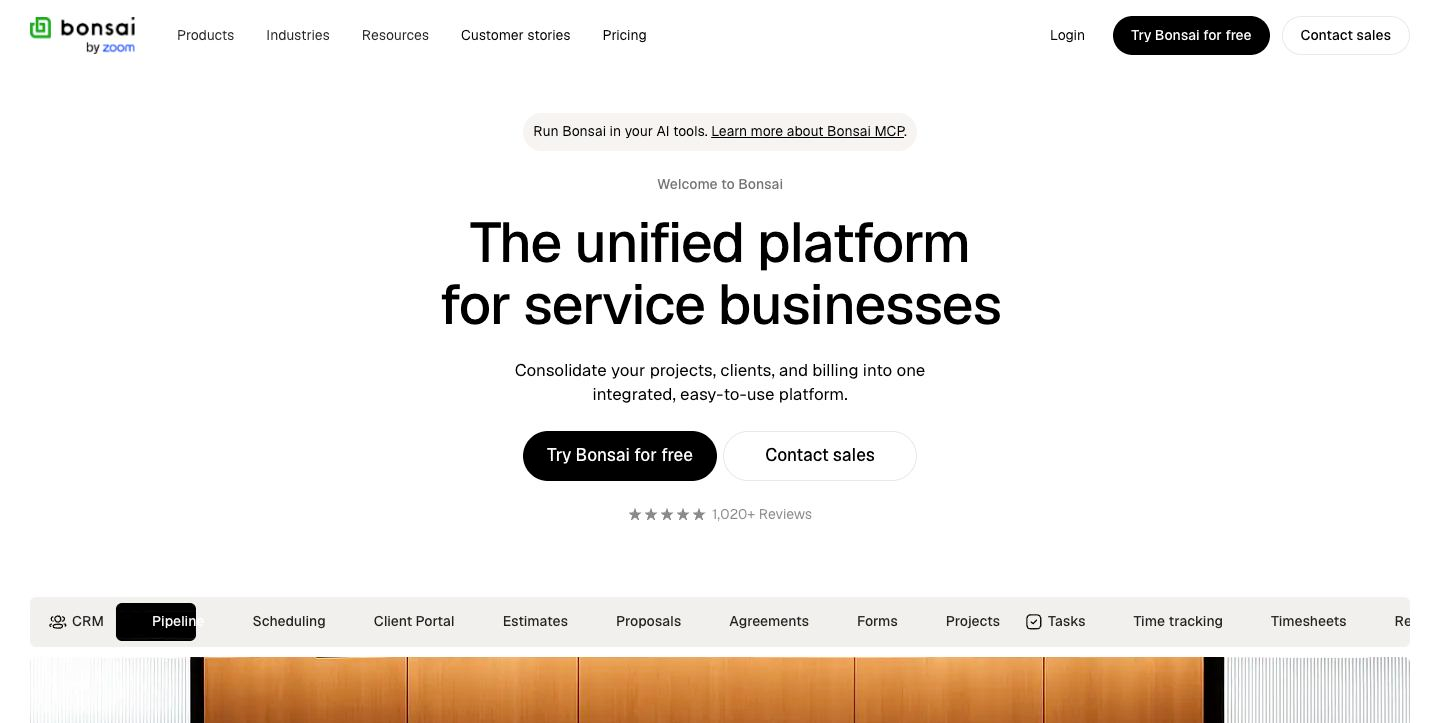
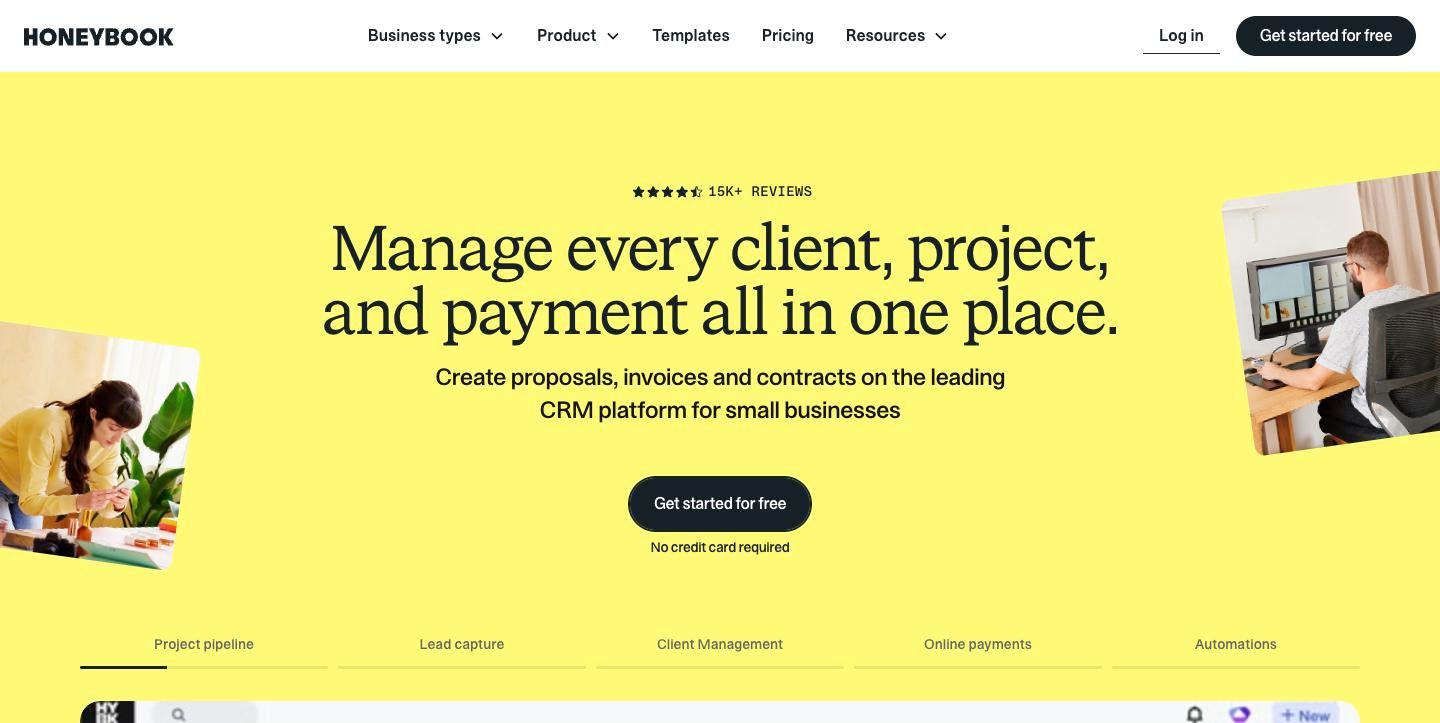
Bonsai is a business, HoneyBook is a client relationship. Bonsai includes time tracking, task management, expense and income tracking, workload views and profit reports — it wants to be the place your whole operation lives. HoneyBook is built around the arc of a single client engagement: inquiry, proposal, contract, payment, done. If most of your work is projects for people who found you, HoneyBook’s shape fits. If you also need to know which of your projects was actually profitable, Bonsai has the reporting and HoneyBook does not.
Lead capture is HoneyBook’s real feature, not its invoicing. Live lead forms — 2 on Starter, 10 on Essentials, unlimited on Premium — feed inquiries straight into the pipeline, and Bonsai has no direct equivalent. If you are marketing yourself and want inbound to land somewhere structured, that is a real advantage. If your clients arrive by referral and email, it is a feature you will never open. Our post on getting more freelance clients without cold pitching covers where those inquiries come from in the first place.
Trials are not equal. HoneyBook gives you 30 days, no credit card. Bonsai gives you 7. Seven days is enough to click around; it is not enough to run a real client through the whole cycle and find out where the software annoys you. Given that these are annual commitments, that difference matters more than it looks. [PLACEHOLDER: captura — la pantalla de facturación de HoneyBook mostrando el toggle anual/mensual con el descuento activo y el precio de Essentials en ambos modos, que es donde se ve que la promo iguala el mensual al anual.]
Pick Bonsai if…
- Your clients are domestic and pay by bank transfer. This is the clearest win in the article: cheaper plan and a cheaper rail, stacking to about $600 a year at a $72,000 book.
- You want time tracking and profitability reporting in the same tool that invoices. HoneyBook simply does not do this, and bolting on a separate tracker costs money and attention — see our time tracking roundup for what that would cost you.
- You are, and intend to stay, one person. Per-seat pricing is a gift at one seat and a tax at two.
- You care about the sticker price and you are willing to buy Premium rather than Basic, because Basic cannot invoice.
The fuller picture of what Bonsai is like day to day is in our Hello Bonsai review, and if you want to see how it stacks against the other automation-heavy option, Dubsado vs Bonsai covers that pair. [AFFILIATE: bonsai]
Pick HoneyBook if…
- More than about $10,000 of your yearly income comes from clients abroad. The 2.5% FX line settles it before you look at anything else.
- Your clients pay by card and you are invoicing north of roughly $120,000 through those cards. Below that number the card advantage does not cover the plan.
- You want inbound inquiries captured in structured forms rather than in your inbox.
- You are about to add a second person and do not want the bill to double.
- You want a month to test properly before committing. Thirty days versus seven is a real difference.
Details on what the entry tier does and does not include are in our HoneyBook review; if you have already decided against it, HoneyBook alternatives and Dubsado vs HoneyBook are the next two stops. [AFFILIATE: honeybook]
Skip both if…
All-in-one platforms make sense when the alternative is five subscriptions and manual copying between them. They stop making sense in two situations.
The first is low volume. If you send four invoices a year, $348 for Bonsai Premium is roughly $87 per invoice in overhead. A free invoicing tool and a contract template will serve you better; we compared the free tiers in best free invoicing software and what each one really costs.
The second is that you already have a stack you like. If your invoicing lives somewhere you trust and your contracts are handled, buying an all-in-one to replace working parts is a migration project disguised as a purchase. Contract software and scheduling tools are both cheap to buy à la carte, and our complete solo toolkit shows what an assembled stack looks like next to an all-in-one. Everything we have written on client-facing paperwork — proposals, contracts and CRMs — sits in the Proposals, Contracts & CRM section, including the wider CRM roundup and our ranked proposal software picks.
A five-minute way to decide
Open your invoicing history for the last twelve months and answer three questions in order. You do not need to finish all three — most people stop at the first or second.
- What share of that money came from clients outside your country? If it is more than about $10,000 a year, choose HoneyBook and stop reading. The FX fee decides it.
- Of the domestic money, how much arrived by bank transfer rather than card? If bank transfer is the majority, choose Bonsai Premium and stop. Cheaper plan, cheaper rail.
- If it is mostly card and mostly domestic, is your card volume above about $120,000? Above it, HoneyBook Essentials edges ahead on total cost. Below it, Bonsai Premium wins on cost and you should decide on the two non-money differences instead: do you need profitability reporting (Bonsai) or lead capture forms (HoneyBook)?
Then use the trials in the right order. Start HoneyBook’s 30-day trial first, because it is long enough to run a real client through it; open Bonsai’s 7-day trial only when you are ready to spend that week deliberately. Doing it the other way around wastes the shorter clock.
Get the free Freelancer Tool Stack
The 18 tools that run a one-person business — invoicing, contracts, time, AI writing, automation and money. One checklist, no fluff.
Frequently asked questions
Is Bonsai cheaper than HoneyBook?
On subscription, yes: the cheapest Bonsai plan that sends unbranded invoices is Premium at $29 per user per month ($348 a year), against HoneyBook Essentials at $49 a month ($588 a year). On total cost it depends on payments — Bonsai is cheaper on bank transfers, HoneyBook is cheaper on cards, and HoneyBook is much cheaper if any of your clients are abroad.
Can I invoice on Bonsai’s $9 plan?
No. Invoices, payments, proposals, contracts and scheduling all begin on the Essentials plan at $19 per user per month billed annually. The $9 Basic plan covers time tracking, tasks, projects and CRM only, which is why the advertised entry price is misleading for anyone who wants to get paid in the tool.
Which one has lower payment processing fees?
Neither, universally. HoneyBook charges 2.7% + $0.10 on cards including American Express; Bonsai charges 2.9% + $0.30 on standard cards and 3.25% + $0.30 on Amex. On bank transfers it reverses: Bonsai is 1.0% with a $1 minimum, HoneyBook is 1.5%. Bonsai also adds 2.5% on internationally paid invoices, and 1% if you route payments through Stripe or PayPal instead of Bonsai Payments.
Do I have to pay for a whole year up front?
No, both sell monthly, but both charge for it. Bonsai’s monthly rates are $15, $25, $39 and $59 against annual rates of $9, $19, $29 and $49 — a premium of 20% to 67% depending on tier. HoneyBook lists Essentials at $59 and Premium at $129 monthly against $49 and $109 annually, though a promotional discount was running when these prices were checked, which temporarily closes that gap.
Can I use my own Stripe account with either one?
With Bonsai you can, at a cost: in countries where Bonsai Payments is available, routing through Stripe or PayPal adds a 1% platform fee on top of the processor’s own rate, rising to 1.35% for American Express. Bonsai also lets you accept wire transfers and checks outside the platform with no fee at all, though you then have to mark invoices paid yourself.
Which is better for a two-person business?
HoneyBook, on price. Bonsai charges per seat, so two people on Premium is $696 a year; HoneyBook Essentials includes up to two team members inside its $588. Bonsai’s per-seat model only wins while you are alone, and its top Elite tier requires a three-user minimum, so a solo freelancer cannot buy it at all.